
Etymology-
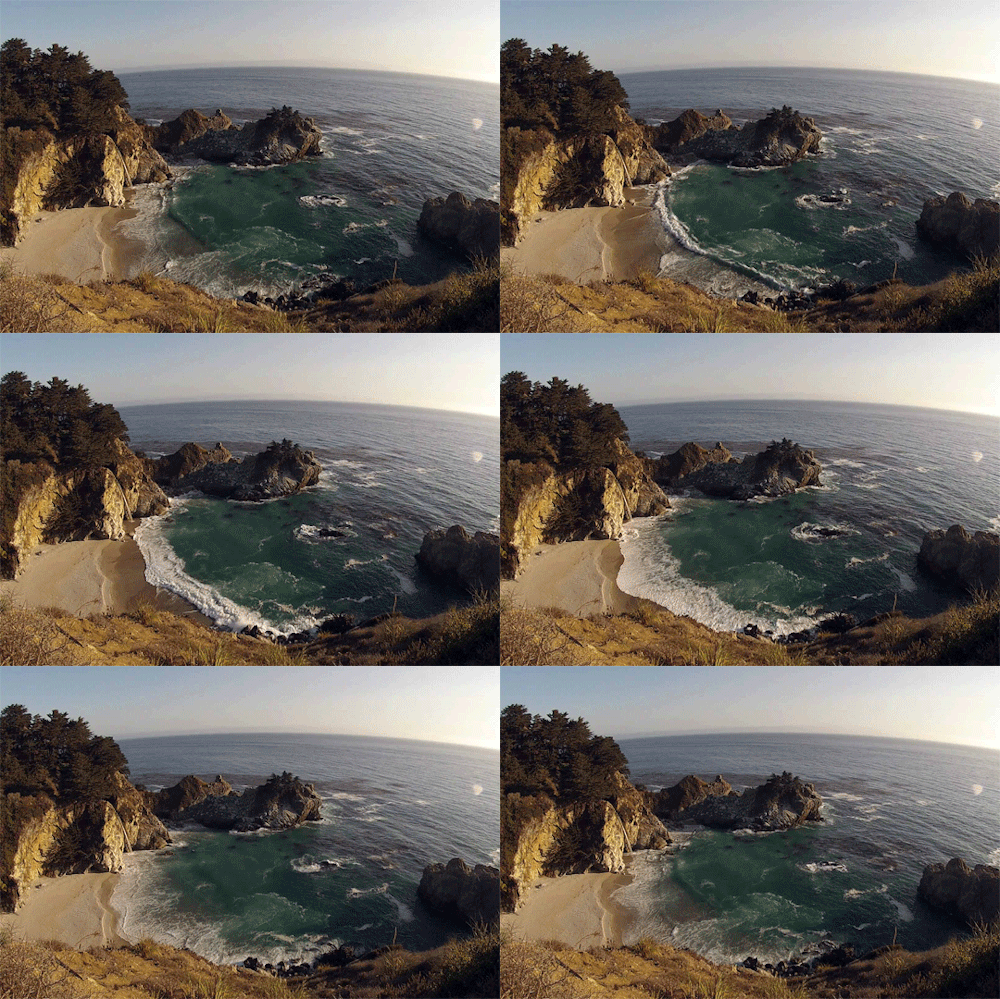
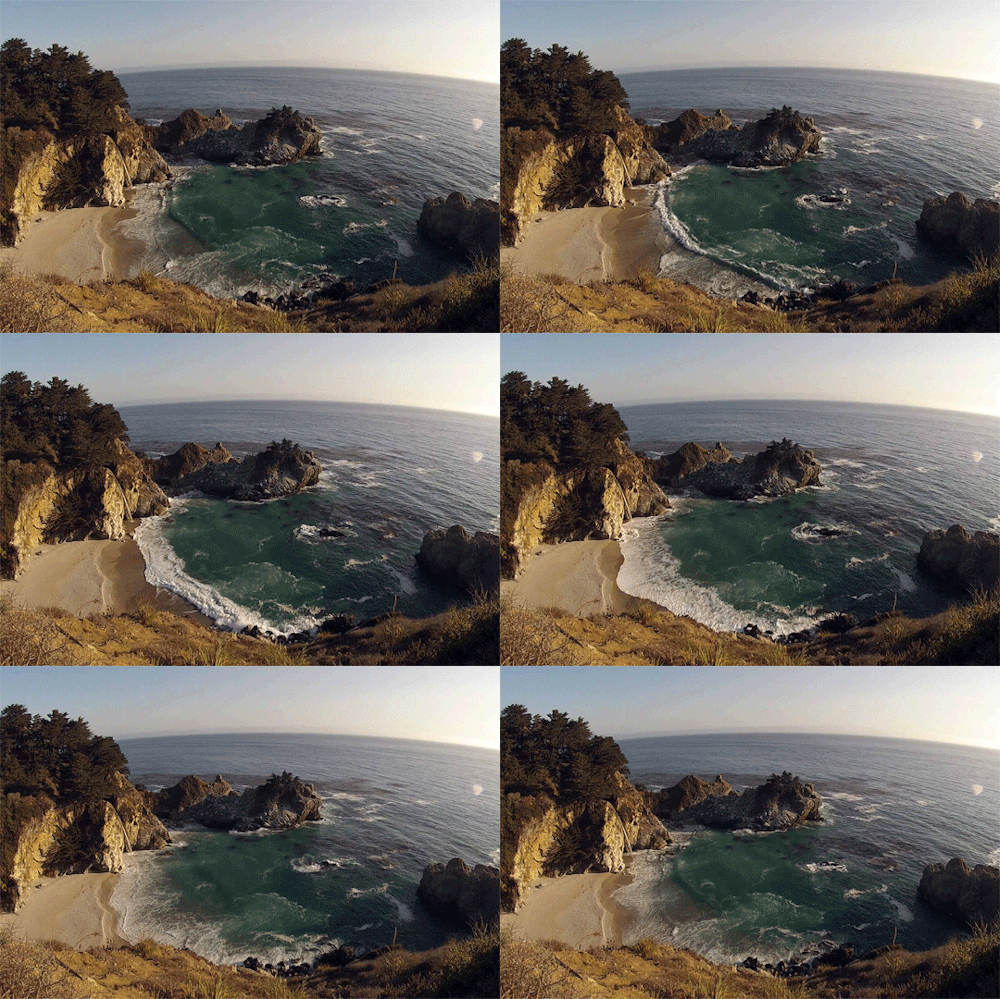
There are several definitions of what constitutes a landscape, depending on context. In common usage however, a landscape refers either to all the visible features of an area of land (usually rural), often considered in terms of aesthetic appeal, or to a pictorial representation of an area of countryside, specifically within the genre oflandscape painting. When people deliberately improve the aesthetic appearance of a piece of land—by changing contours and vegetation, etc.—it is said to have beenlandscaped, though the result may not constitute a landscape according to some definitions.
The word landscape (landscipe or landscaef) arrived in England—and therefore into the English language—after the fifth century, following the arrival of the Anglo-Saxons; these terms referred to a system of human-made spaces on the land. The term "landscape" emerged around the turn of the sixteenth century to denote a painting whose primary subject matter was natural scenery. "Land" (a word from Germanic origin) may be taken in its sense of something to which people belong (as in England being the land of the English). The suffix "‑scape" is equivalent to the more common English suffix "‑ship." The roots of "‑ship" are etymologically akin to Old English sceppan or scyppan, meaning to shape. The suffix ‑schaft is related to the verb schaffen, so that ‑ship and shape are also etymologically linked. The modern form of the word, with its connotations of scenery, appeared in the late sixteenth century when the termlandschap was introduced by Dutch painters who used it to refer to paintings of inland natural or rural scenery. The word "landscape", first recorded in 1598, was borrowed from a Dutch painters' term. The popular conception of the landscapethat is reflected in dictionaries conveys both a particular and a general meaning, the particular referring to an area of the Earth's surface and the general being that which can be seen by an observer.
Geomorphology: The physical evolution of landscape-
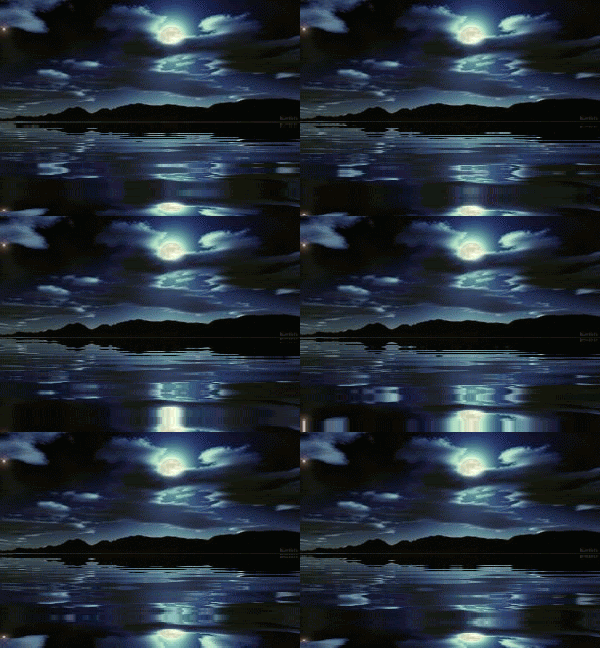
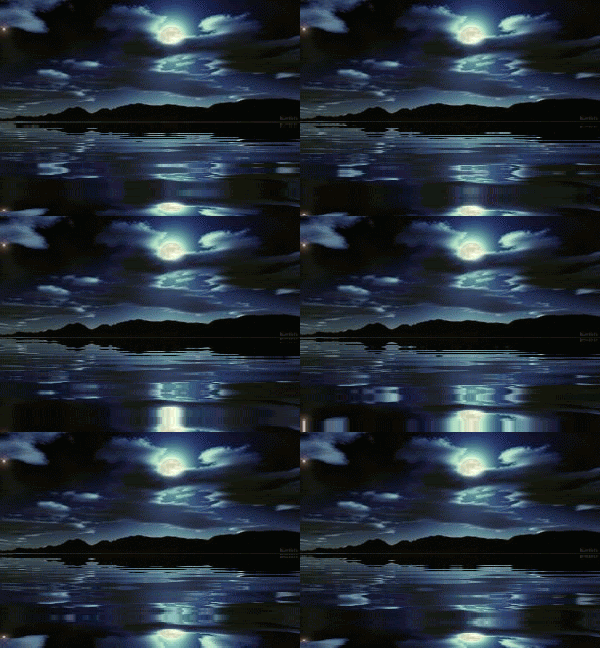
Geomorphology is the scientific study of the origin and evolution of topographic and bathymetric features created by physical or chemical processes operating at or near Earth's surface. Geomorphologists seek to understand why landscapes look the way they do, to understand landform history and dynamics and to predict changes through a combination of field observations, physical experiments and numerical modeling. Geomorphology is practiced within physical geography,geology, geodesy, engineering geology, archaeology and geotechnical engineering. This broad base of interests contributes to many research styles and interests within the field.
The surface of Earth is modified by a combination of surface processes that sculpt landscapes, and geologic processes that cause tectonic uplift and subsidence, and shape the coastal geography. Surface processes comprise the action of water,wind, ice, fire, and living things on the surface of the Earth, along with chemical reactions that form soils and alter material properties, the stability and rate of change of topography under the force of gravity, and other factors, such as (in the very recent past) human alteration of the landscape. Many of these factors are strongly mediated by climate. Geologic processes include the uplift of mountain ranges, the growth of volcanoes, isostatic changes in land surface elevation (sometimes in response to surface processes), and the formation of deep sedimentary basins where the surface of Earth drops and is filled with material eroded from other parts of the landscape. The Earth surface and its topography therefore are an intersection of climatic, hydrologic, and biologic action with geologic processes.
Landscape ecology-
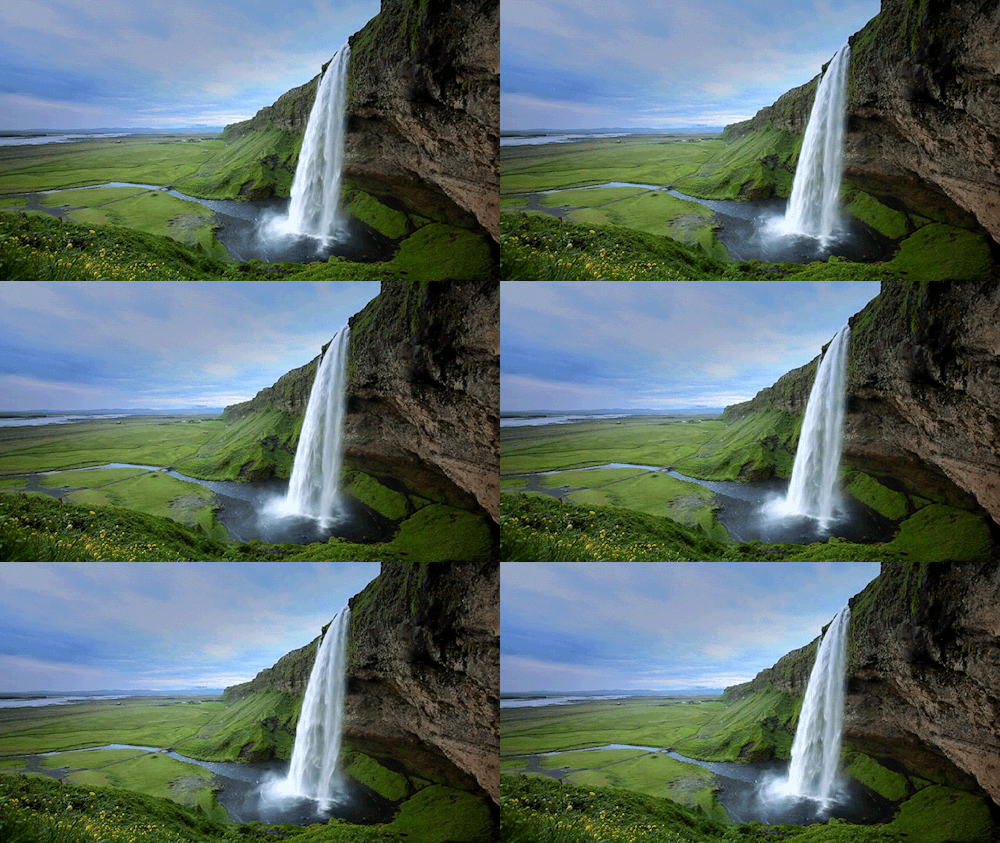
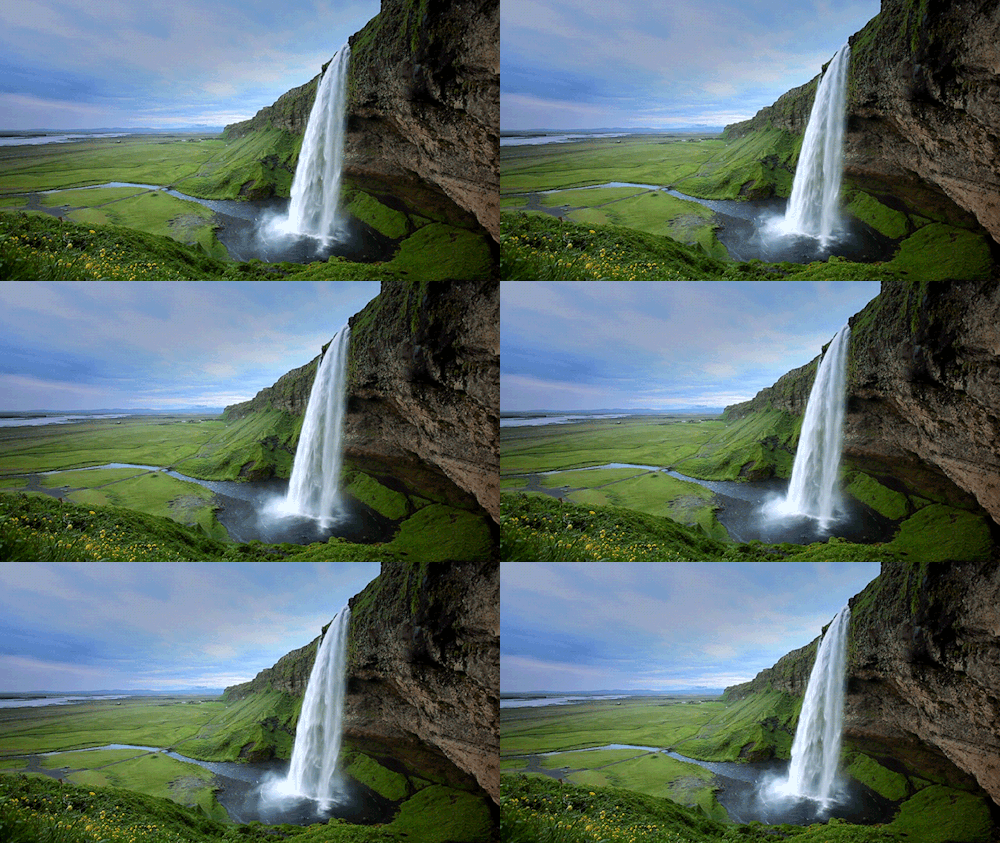
Landscape ecology is the science of studying and improving relationships between ecological processes in the environment and particular ecosystems. This is done within a variety of landscape scales, development spatial patterns, and organizational levels of research and policy.
Landscape is a central concept in landscape ecology. It is, however, defined in quite different ways. For example: Carl Troll conceives of landscape not as a mental construct but as an objectively given ‘organic entity’, a ‘‘harmonic individuum of space’’. Ernst Neef defines landscapes as sections within the uninterrupted earth-wide interconnection of geofactors which are defined as such on the basis of their uniformity in terms of a specific land use, and are thus defined in an anthropocentric and relativistic way.
According to Richard Forman and Michael Godron, a landscape is a heterogeneous land area composed of a cluster of interacting ecosystems that is repeated in similar form throughout, whereby they list woods, meadows, marshes and villages as examples of a landscape’s ecosystems, and state that a landscape is an area at least a few kilometres wide. John A. Wiens[15] opposes the traditional view expounded by Carl Troll, Isaak S. Zonneveld, Zev Naveh, Richard T. T. Forman/Michel Godron and others that landscapes are arenas in which humans interact with their environments on a kilometre-wide scale; instead, he defines 'landscape'—regardless of scale—as "the template on which spatial patterns influence ecological processes". Some define 'landscape' as an area containing two or more ecosystems in close proximity.


Landscape Garden-
The Chinese garden is a landscape garden style which has evolved over three thousand years. It includes both the vast gardens of the Chinese emperors and members of the Imperial Family, built for pleasure and to impress, and the more intimate gardens created by scholars, poets, former government officials, soldiers and merchants, made for reflection and escape from the outside world. They create an idealized miniature landscape, which is meant to express the harmony that should exist between man and nature. A typical Chinese garden is enclosed by walls and includes one or more ponds, scholar's rocks, trees and flowers, and an assortment of halls and pavilions within the garden, connected by winding paths and zig-zag galleries. By moving from structure to structure, visitors can view a series of carefully composed scenes, unrolling like a scroll of landscape paintings.
The English landscape garden, also called English landscape park or simply the 'English garden', is a style of parkland garden intended to look as though it might be a natural landscape, although it may be very extensively re-arranged. It emerged in England in the early 18th century, and spread across Europe, replacing the more formal, symmetrical jardin à la française of the 17th century as the principal style for large parks and gardens in Europe. The English garden (and later French landscape garden) presented an idealized view of nature. It drew inspiration from paintings of landscapes by Claude Lorraine and Nicolas Poussin, and from the classic Chinese gardens of the East, which had recently been described by European travellers and were realized in the Anglo-Chinese garden, and the philosophy of Jean-Jacques Rousseau (1712 – 1778).
The English garden usually included a lake, sweeps of gently rolling lawns set against groves of trees, and recreations of classical temples, Gothic ruins, bridges, and other picturesque architecture, designed to recreate an idyllic pastoral landscape. The work of Lancelot "Capability" Brown and Humphry Repton was particularly influential. By the end of the 18th century the English garden was being imitated by the French landscape garden, and as far away as St. Petersburg, Russia, in Pavlovsk, the gardens of the future Emperor Paul. It also had a major influence on the form of the public parks and gardens which appeared around the world in the 19th century.
Landscape architecture-
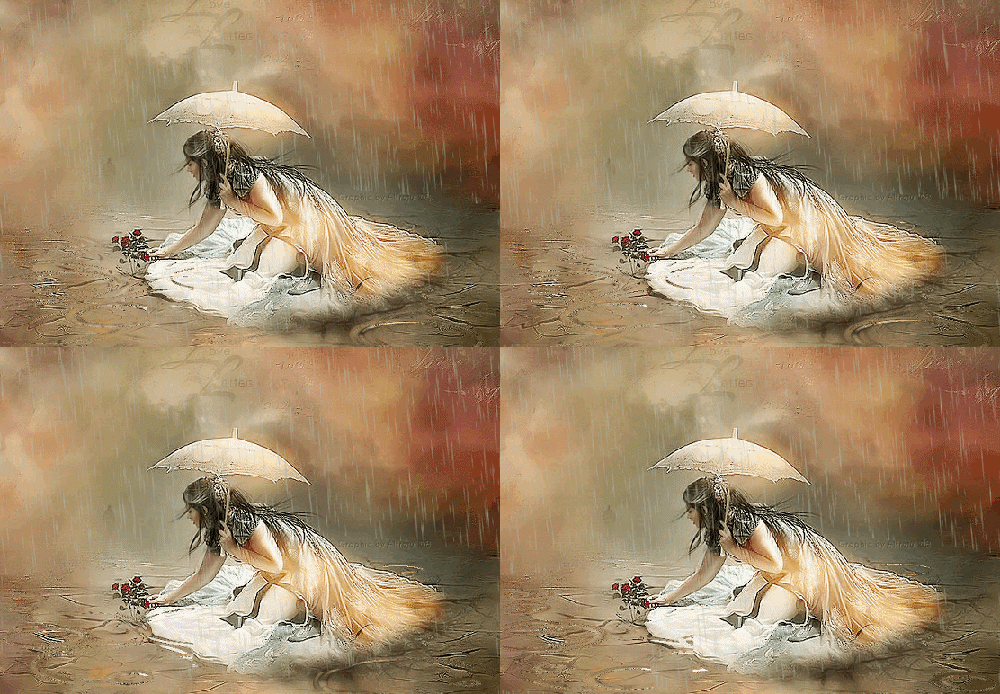
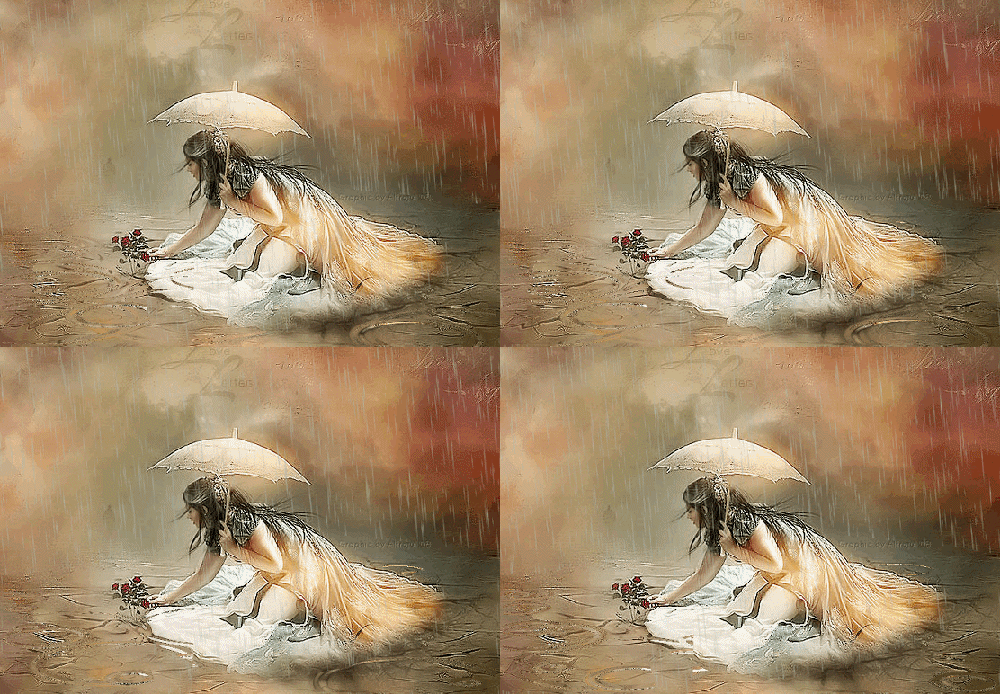
Landscape architecture is a multi-disciplinary field, incorporating aspects ofbotany, horticulture, the fine arts, architecture, industrial design, geology and the earth sciences, environmental psychology, geography, and ecology. The activities of a landscape architect can range from the creation of public parks and parkways to site planning for campuses and corporate office parks, from the design of residential estates to the design of civil infrastructure and the management of large wilderness areas or reclamation of degraded landscapes such as mines or landfills. Landscape architects work on all types of structures and external space – large or small, urban, suburban and rural, and with "hard" (built) and "soft" (planted) materials, while paying attention to ecologicalsustainability.
For the period before 1800, the history of landscape gardening (later called landscape architecture) is largely that of master planning and garden design for manor houses, palaces and royal properties, religious complexes, and centers of government. An example is the extensive work by André Le Nôtre at Vaux-le-Vicomte and at the Palace of Versailles for KingLouis XIV of France. The first person to write of making a landscape was Joseph Addison in 1712. The term landscape architecture was invented by Gilbert Laing Meason in 1828 and was first used as a professional title by Frederick Law Olmsted in 1863. During the latter 19th century, the term landscape architect became used by professional people who designed landscapes. Frederick Law Olmsted used the term 'landscape architecture' as a profession for the first time when designing Central Park, New York City, US. Here the combination of traditional landscape gardening and the emerging field of city planning gave landscape architecture its unique focus. This use of the term landscape architect became established after Frederick Law Olmsted, Jr. and others founded the American Society of Landscape Architects (ASLA) in 1899.
Landscape & Literature-
Possibly the earliest landscape literature is found in Australian aboriginal myths(also known as Dreamtime or Dreaming stories, songlines, or Aboriginal oral literature), the stories traditionally performed by Aboriginal peoples[37] within each of the language groups across Australia. All such myths variously tell significant truths within each Aboriginal group's local landscape. They effectively layer the whole of the Australian continent's topography with cultural nuance and deeper meaning, and empower selected audiences with the accumulated wisdom and knowledge of Australian Aboriginal ancestors back totime immemorial.
In the West pastoral poetry represent the earliest form of landscape literature, though this literary genre presents an idealized landscape peopled by shepherds and shepherdesses, and creates "an image of a peaceful uncorrupted existence; a kind of prelapsarianworld".[39] The pastoral has its origins in the works of the Greek poet Theocritus (c. 316 - c. 260 BC). The Romantic periodpoet William Wordsworth created a modern, more realistic form of pastoral with Michael, A Pastoral Poem (1800).
An early form of landscape poetry, Shanshui poetry, developed in China during the third and fourth centuries A.D. Shanshui poetry (or Shanshui chi, traditional Chinese:simplified Chinese:lit. mountains and rivers poetry) refers to the movement in poetry, influenced by the shan shui (landscape) painting style. Sometimes, the poems were designed to be viewed with a particular work of art, others were intended to be textual art that invoked an image inside a reader's mind. It is one of the more important Classical Chinese poetry genres.
Although landscape images were present in the earlier Shijing and the Chuci, the unique development in Shanshui poetry was that the main focus became on the natural landscape, rather than the use of nature as a backdrop for the human presence.


Landscape Painting-
The earliest forms of art around the world depict little that could really be calledlandscape, although ground-lines and sometimes indications of mountains, trees or other natural features are included. The earliest "pure landscapes" with no human figures are frescos from Minoan Greece of around 1500 BCE. Hunting scenes, especially those set in the enclosed vista of the reed beds of the Nile Delta from Ancient Egypt, can give a strong sense of place, but the emphasis is on individual plant forms and human and animal figures rather than the overall landscape setting. For a coherent depiction of a whole landscape, some rough system of perspective, or scaling for distance, is needed, and this seems from literary evidence to have first been developed in Ancient Greece in the Hellenistic period, although no large-scale examples survive. More ancient Roman landscapes survive, from the 1st century BCE onwards, especially frescos of landscapes decorating rooms that have been preserved at archaeological sites of Pompeii, Herculaneum and elsewhere, and mosaics.
The Chinese ink painting tradition of shan shui ("mountain-water"), or "pure" landscape, in which the only sign of human life is usually a sage, or a glimpse of his hut, uses sophisticated landscape backgrounds to figure subjects, and landscape art of this period retains a classic and much-imitated status within the Chinese tradition.
Both the Roman and Chinese traditions typically show grand panoramas of imaginary landscapes, generally backed with a range of spectacular mountains – in China often with waterfalls and in Rome often including sea, lakes or rivers. These were frequently used to bridge the gap between a foreground scene with figures and a distant panoramic vista, a persistent problem for landscape artists.
A major contrast between landscape painting in the West and East Asia has been that while in the West until the 19th century it occupied a low position in the accepted hierarchy of genres, in East Asia the classic Chinese mountain-water ink painting was traditionally the most prestigious form of visual art. However, in the West, history painting came to require an extensive landscape background where appropriate, so the theory did not entirely work against the development of landscape painting – for several centuries landscapes were regularly promoted to the status of history painting by the addition of small figures to make a narrative scene, typically religious or mythological.
Dutch Golden Age painting of the 17th century saw the dramatic growth of landscape painting, in which many artists specialized, and the development of extremely subtle realist techniques for depicting light and weather. The popularity of landscapes in the Netherlands was in part a reflection of the virtual disappearance of religious painting in a Calvinist society, and the decline of religious painting in the 18th and 19th centuries all over Europe combined with Romanticism to give landscapes a much greater and more prestigious place in 19th-century art than they had assumed before.
In England, landscapes had initially been mostly backgrounds to portraits, typically suggesting the parks or estates of a landowner, though mostly painted in London by an artist who had never visited the site. the English tradition was founded by Anthony van Dyck and other, mostly Flemish, artists working in England. By the beginning of the 19th century the English artists with the highest modern reputations were mostly dedicated landscapists, showing the wide range of Romanticinterpretations of the English landscape found in the works of John Constable, J.M.W. Turner and Samuel Palmer. However all these had difficulty establishing themselves in the contemporary art market, which still preferred history paintings and portraits.
In the United States, the Hudson River School, prominent in the middle to late 19th century, is probably the best-known native development in landscape art. These painters created works of mammoth scale that attempted to capture the epic scope of the landscapes that inspired them. The work of Thomas Cole, the school's generally acknowledged founder, has much in common with the philosophical ideals of European landscape paintings — a kind of secular faith in the spiritual benefits to be gained from the contemplation of natural beauty. Some of the later Hudson River School artists, such asAlbert Bierstadt, created less comforting works that placed a greater emphasis (with a great deal of Romantic exaggeration) on the raw, even terrifying power of nature. The best examples of Canadian landscape art can be found in the works of theGroup of Seven, prominent in the 1920s.[65] Emily Carr was also closely associated with the Group of Seven, though was never an official member. Although certainly less dominant in the period after World War I, many significant artists still painted landscapes in the wide variety of styles exemplified by Neil Welliver, Alex Katz, Milton Avery, Peter Doig, Andrew Wyeth, David Hockney and Sidney Nolan.

